I built a production AI product solo in ten months. This is how I think.
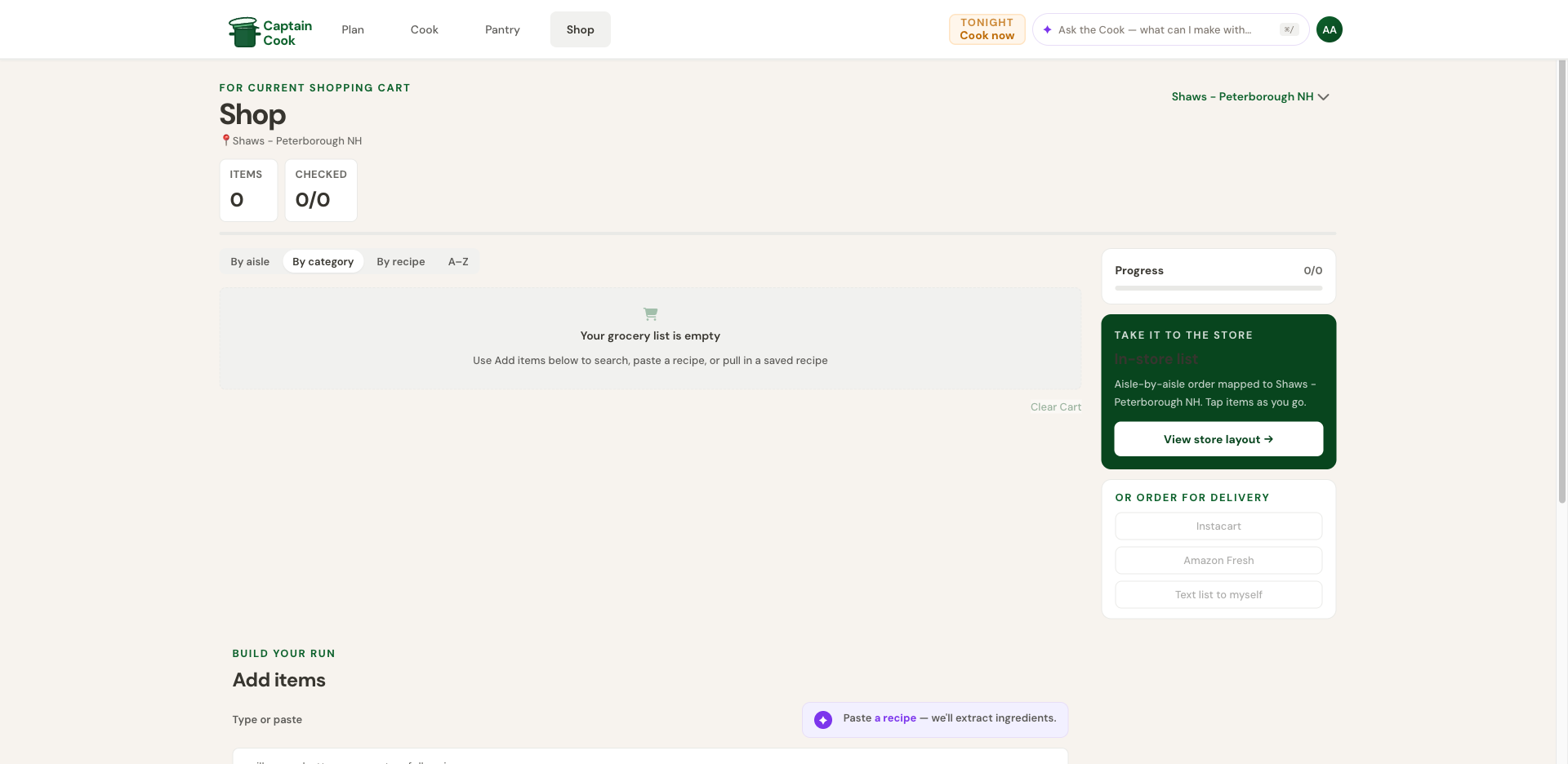
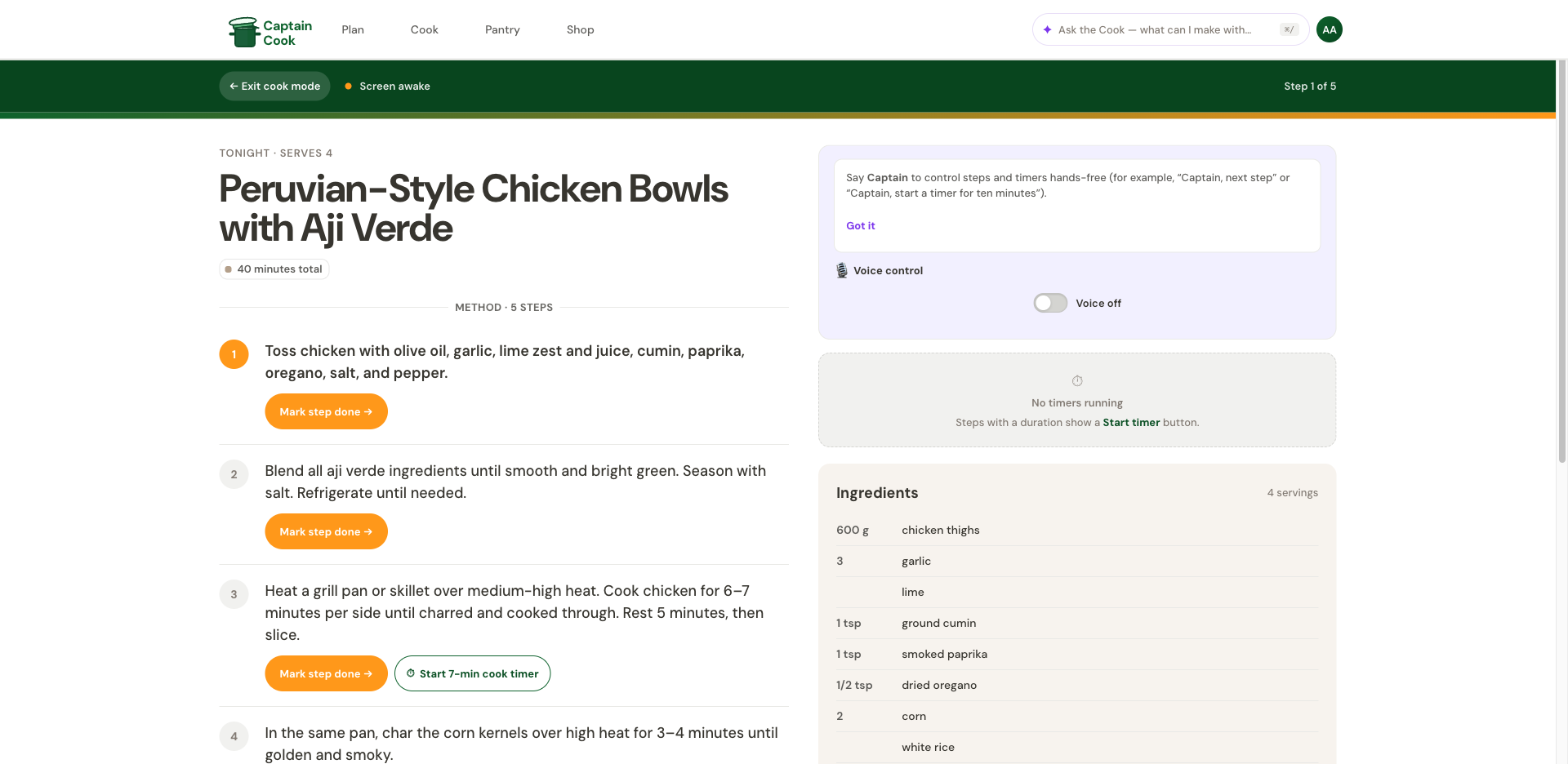
Captain Cook turns the recipes you already trust into a week you can actually cook: plan it, audit the ingredient gap, shop, cook, repeat.
A side project, not a startup — built to sharpen my product thinking while I look for the next role, and to prove that AI-assisted development can produce something real, not just a demo.
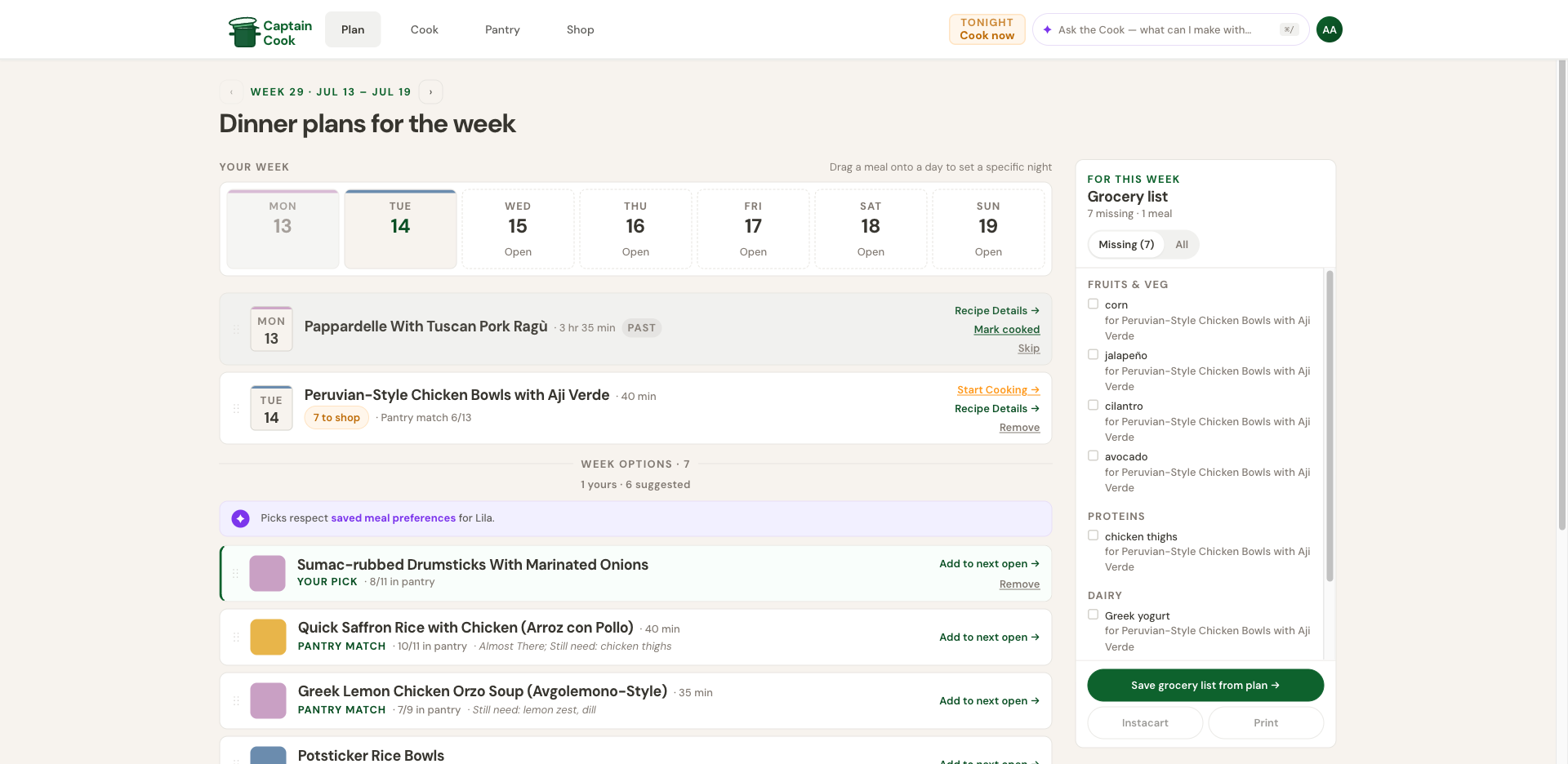
The problem
People already have recipes they trust — scattered across bookmarks, screenshots, and cookbooks. Cooking was never the hard part. Deciding what to cook, and figuring out what's missing from the pantry, is what kills the week.
"Buy 4–5 items. Unlock 2–3 good meals this week."
That's the whole wedge. Not another recipe app — an operating system for the recipes you already picked.
The loop is the product
Not a feature list. Every feature exists to protect this cycle — and to get users back to step one, next week.
import → plan → audit gap → shop → cook → return next week
Three decisions that show how I think
Collapsed by default. Expand any one for the full situation → options → rationale.
1. Plan-first information architecture +
- Situation
- Early product surfaces were recipe- and chat-centric. The real job — weekly planning with ingredient-gap visibility — wasn't the default mental model.
- Options
- (1) keep recipes as home, tuck planning under a sub-feature · (2) add a "Meals" tab without restructuring · (3) reorder top-level nav to Plan → Cook → Pantry → Shop, and show a Plan preview before signup
- Decision
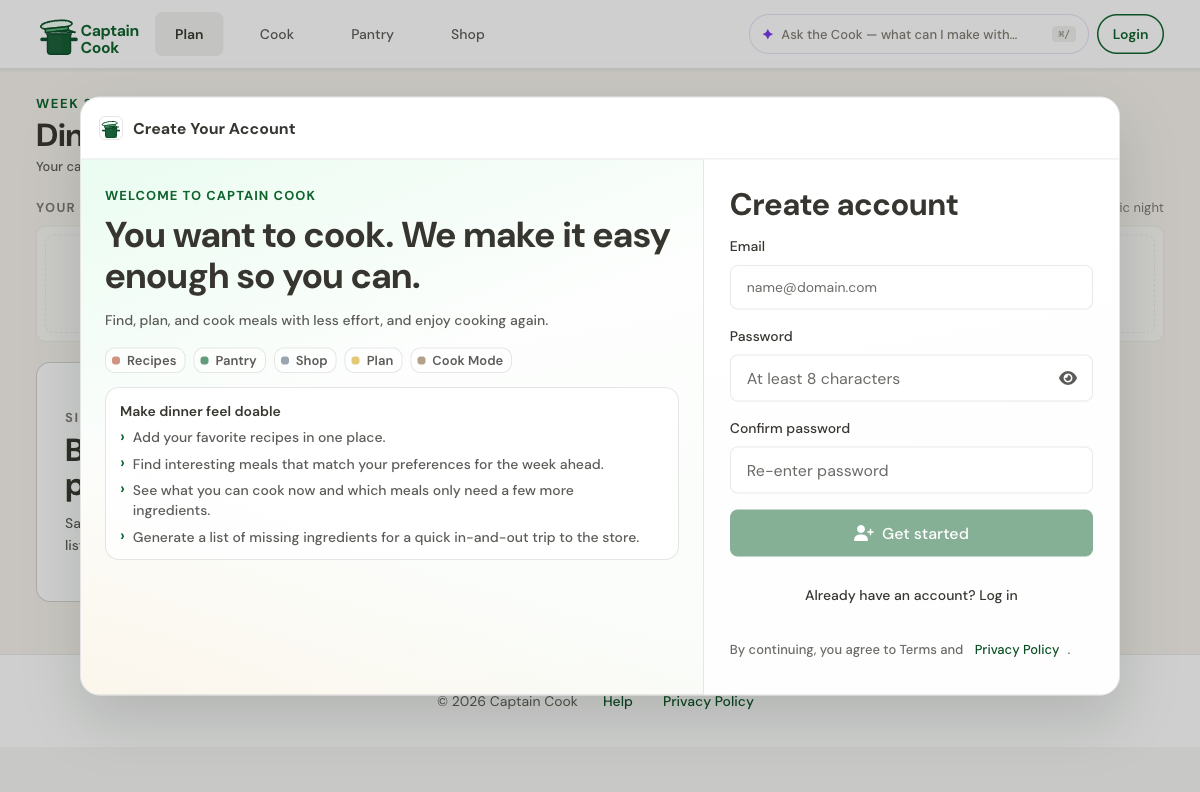
- Option 3. Plan is the first tab. Logged-out users see a Plan preview behind onboarding.
- Why
- "If people land on the recipe library and just browse, the product becomes another recipe app. Differentiation isn't content scale — it's operationalizing the recipes someone already trusts."
2. Recipe packs: bootstrap, not the brand +
- Situation
- New users with an empty recipe library can't get meaningful planner suggestions or pantry-match scores.
- Options
- (1) rely entirely on import flows · (2) ship curated recipe packs · (3) license publisher content catalogs
- Decision
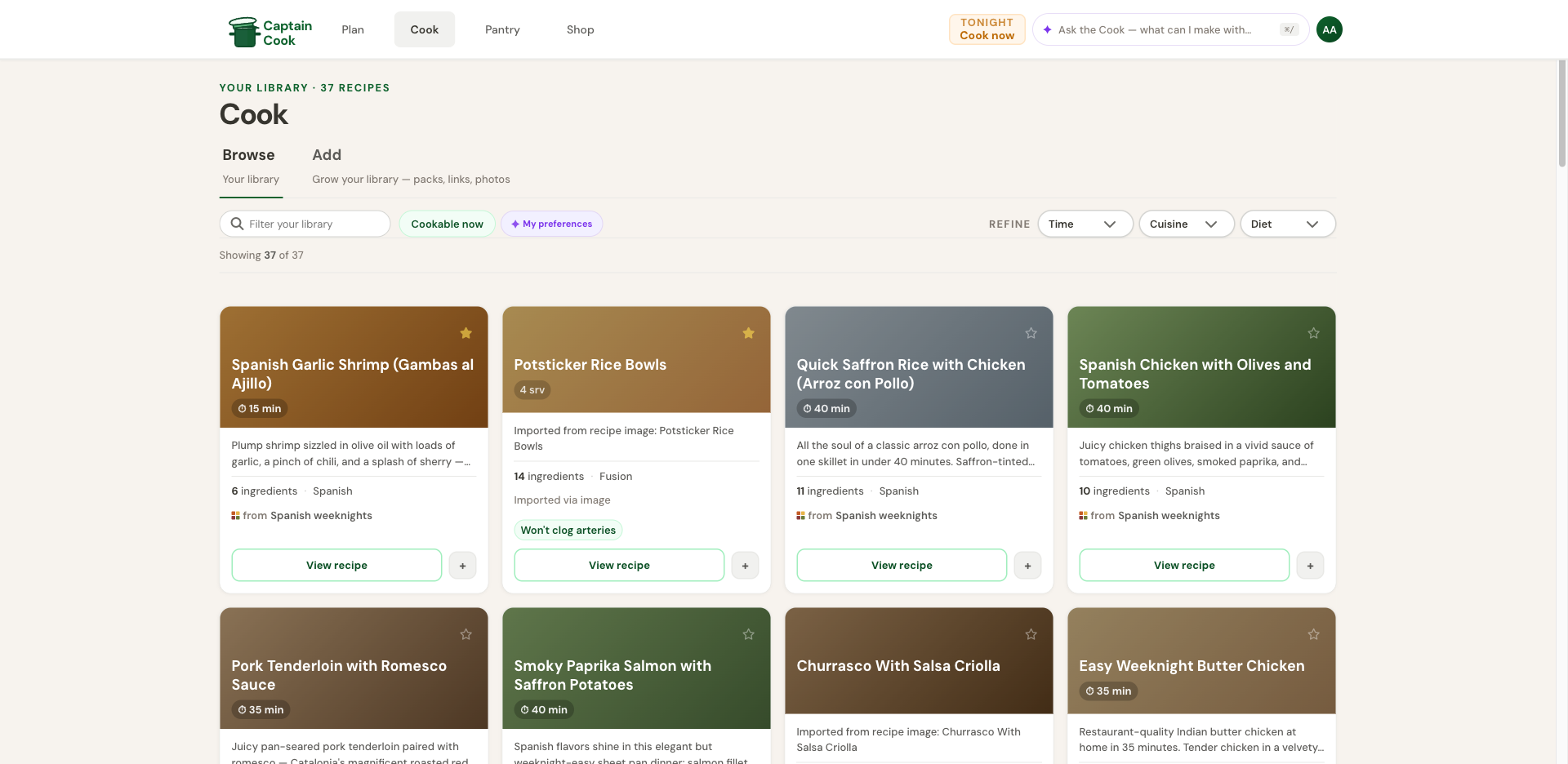
- Option 2, with a guardrail: messaging always leads with "your recipes" before "our packs."
- Why
- "Packs reduce time-to-first-plan but don't create a moat. Publisher catalogs would reposition this as another content app."
3. Let chat earn its place +
- Situation
- A planner-chat layer could feel magical — or add friction on tasks users finish faster by direct manipulation.
- Options
- (1) launch a prominent autonomous planning agent · (2) ship "Ask the Cook" as a global launcher for ad-hoc questions only · (3) a compound-request planner assistant, feature-flagged
- Decision
- Option 2 shipped as default; Option 3 prototyped behind a flag. In July 2026, "Ask the Cook" moved from a top-level nav tab to an assistive launcher once it competed with structured planning.
- Why
- "Generic chat on top of a planner is a novelty trap. AI earns its place on judgment-heavy, multi-step changes — not on tasks people finish faster themselves."
Where this stands — and what would prove me wrong
I'd rather show an honest diagnosis, paired with the specific test that would resolve it, than a growth chart that wouldn't mean anything for a project this size.
| Dimension | Status |
|---|---|
| Core planning-to-execution loop | Shipped |
| Product-market fit | Hypothesis |
| Adoption cohort | Not yet run |
| Open question | Do people discover Plan and come back next week? |
Is the "escape the rut" segment real and big enough — or founder-market-fit of one?
Named directly, not glossed over. Two specific, falsifiable failure modes — not resolved by more reasoning, only by the first cohort:
Under the hood
Technical depth, reframed for outcomes — not a tech demo bolted onto a product pitch.
- Confidence-based routing — the orchestrator classifies intent and only routes to a specialist agent above a 0.6 confidence threshold; below it, it asks a clarifying question instead of guessing.
- Bounded vs. open-ended AI, deliberately split — Cook Mode voice control and the planner assistant use deterministic parsers first, falling back to an LLM only when needed.
- One vector store, not two — consolidated pgvector into the primary Postgres database, migrated off a separate ChromaDB instance, eliminating sync bugs.
- Evaluation as a first-class system — 27+ LLM-judged test cases across 9 categories, daily regression runs, production-query replay against a baseline.
Market rigor, not just internal conviction
Benchmarked feature-by-feature against 7 named, shipping competitors — the kind of homework that separates a hopeful side project from a founder who understands the category.
The differentiator, and its real limit
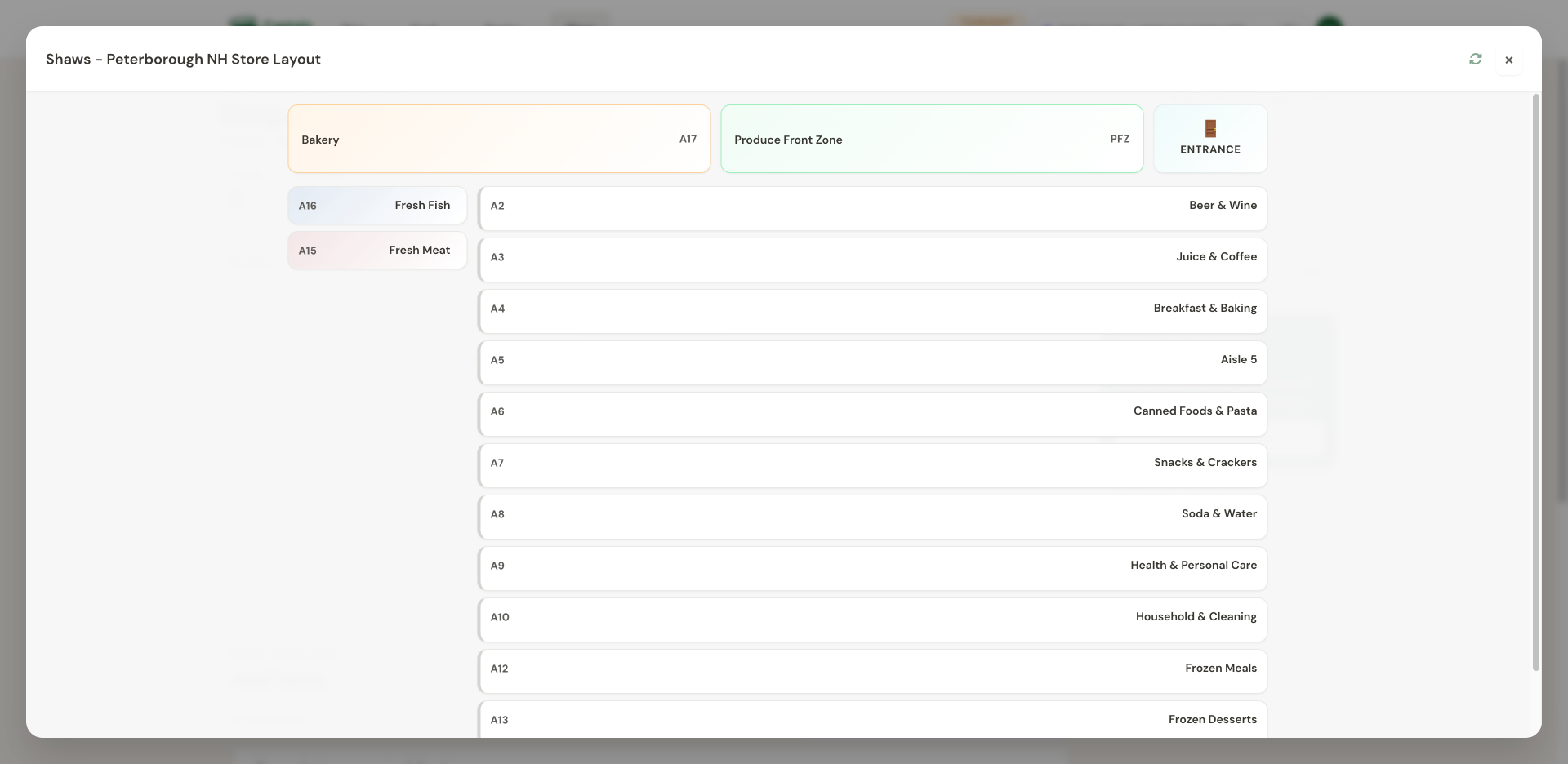
The store-layout schematic — a visual, chain-specific, auto-maintained item-location map — is a genuine first; no benchmarked competitor has attempted it, and even Instacart's closest pilot covered only ~80 stores. But there's no importable planogram dataset: every new chain is real, bounded, manual work. Not a self-scaling moat — a deliberate operational investment nobody else is bothering to make.
The verdict, stated honestly
"Yes, as a combination — not yet as a moat." The full loop doesn't exist intact anywhere else today, but it's assembled from parts that individually exist elsewhere. Real, but time-limited against a well-resourced fast-follower — see below.
"Samsung Food is the most structurally dangerous competitor — free-adjacent, well-funded, and already converging on the same thesis with far more resources."
Naming that threat directly, rather than only listing strengths, is the point: competitive self-awareness reads more credible than a strengths-only pitch. The response: own the emotional positioning ("escape the rut," not health-optimization or content scale) a large incumbent is slower to copy than a feature — and build the premium tier on the multi-agent architecture, not recipe count.
Path to viability: 0 → 1 on paying subscribers
Not a promise this happens — proof the thinking is already done, if I choose to pursue it.
Prove the differentiator, live
- Recruit the initial cohort from the Hannaford's/Shaw's region — a targeting decision, not a build item — so the store map is demoable for every user, not a fallback.
- Ship a minimal "list, not cart" Instacart handoff sized around the gap-audit's short list.
- Write the "why not just use Paprika + AnyList" objection and its answer, led with the store schematic.
Let data replace assumption
- Instrument the full funnel so retention data shows exactly where the loop breaks.
- Pressure-test whether AI recommendations actually feel smart to a first-time user before leaning on that claim in marketing.
Build the moat, once earned
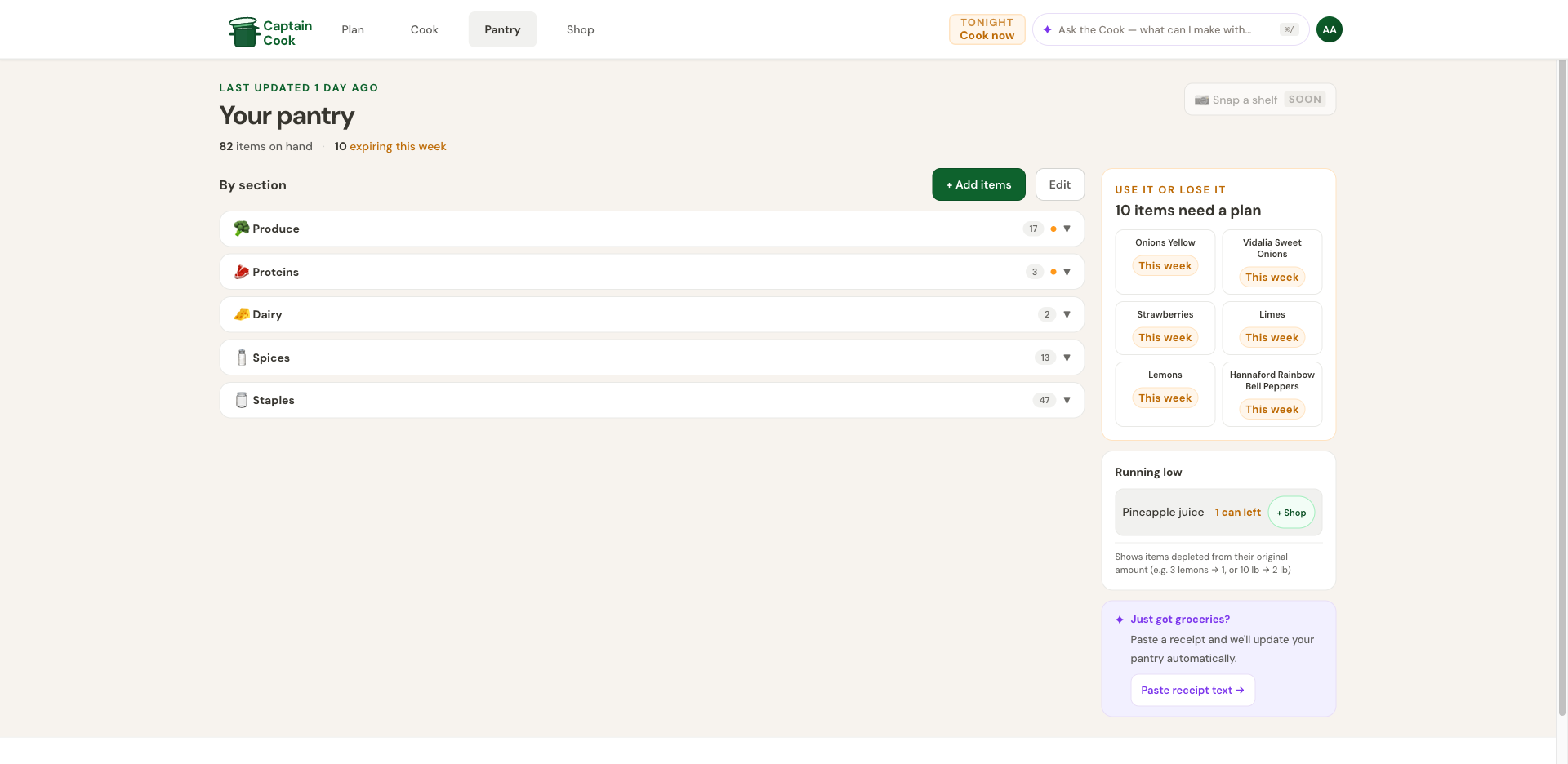
- Decide pantry auto-population investment based on real drop-off data, not guesswork.
- Build the premium tier on the multi-agent architecture — a conversational "what can I make with what's expiring" capability filter-based competitors can't easily copy.
How the thinking evolved
Ten months, three real phases — strategy and implementation converged, they didn't arrive together.
What this demonstrates
Said no, on purpose
Turned down discovery-first positioning, publisher content catalogs, and a prominent autonomous planning agent — each faster to ship than what shipped instead.
Named the hypothesis as a hypothesis
Defined a north-star metric and activation funnel before a single cohort existed, and says so plainly.
Shipped in weeks, alone
Plan, Cook, Pantry, Shop, Cook Mode, packs, and onboarding — while deliberately deferring grocer integrations until retention data justifies the cost.
Knows where AI helps — and where it doesn't
Built orchestration, evaluation, and prompt governance that mirror how real AI products are run — and put AI in the back seat wherever direct manipulation was simply faster.
What I'd do differently with a team
- Run the founding cohort before the last mile of polish on the Shop handoff.
- Pair with a designer earlier on Plan-first onboarding experiments.
- Dedicate an engineer to loop instrumentation in parallel with feature work — metrics debt is now on the critical path.